
How to Check Criminal History in Uvalde County
There is no complete countywide person search. Start by deciding what the result must prove. The Uvalde County Jail can confirm present custody and booking allegations. The District Clerk holds felony cases in the 38th District Court, while the County Clerk holds Class A and B misdemeanor files. Uvalde and Sabinal municipal courts keep their own fine-only matters. A statewide public conviction or deferred-adjudication entry comes from Texas DPS, and TDCJ becomes the right locator after a person enters state custody.
Gather a full legal name, spelling variants, an approximate date range, and a case, citation, report, or booking number when one is known. Date of birth can help distinguish common names, but give sensitive data only through an official channel that asks for it. Then follow the record to its owner:
- Call the jail for current custody or the appropriate clerk for a filed court case.
- Search the Uvalde citation portal only when a citation number is known, or contact Sabinal Municipal Court by phone.
- Use the DPS public name product for the statewide public conviction and deferred-adjudication subset.
- Request the arrest report from the arresting agency and the judgment from the clerk that owns the case.
- Order a certified copy when the disposition must be proved, or use FAST fingerprints to review your own Texas record.
The official Uvalde County directory is the best starting map for county offices.
Its department links route readers to the sheriff and clerks without implying that the county offers one combined database.
No One-Click Uvalde County Record Search
Uvalde County criminal records form a chain. An officer creates an incident or arrest report. Jail staff create a booking record if the person enters the county facility. Prosecutors decide which charge, if any, to file. A clerk then opens the proper case, and the court later reports a disposition to DPS. Those steps may happen at different times, so one system can lag behind another. A “no matching records” message from DPS does not rule out a recent local arrest, a municipal citation, or a case that has not reached the repository.
| Question | First channel | What it establishes |
|---|---|---|
| Is the person in local custody? | Uvalde County Jail phone | Current custody and listed booking allegations |
| What did the court decide? | District, County, JP, or municipal clerk | Filed case, orders, judgment, and sentence |
| What did the officer report? | Arresting agency request | Releasable incident or arrest material |
| What public history reached Texas? | DPS conviction name search | Disclosable statewide CCH subset |
Note: Match the result to its source before treating a charge label, bond entry, or name match as a final outcome.
Official Texas Background Checks
The Texas Department of Public Safety Crime Records Division maintains the state Computerized Criminal History system. Any registered public user may purchase a credit and run the public name search. That product mainly returns convictions, deferred adjudications, and their associated arrests when Texas law allows release. It is not a complete fingerprint rap sheet. For an identity-reliable review of their own Texas record, a person follows the DPS Review of Personal Criminal History process and has fingerprints captured through FAST at an IdentoGO location.
The Texas DPS public search interface requires an account and prepaid credits.
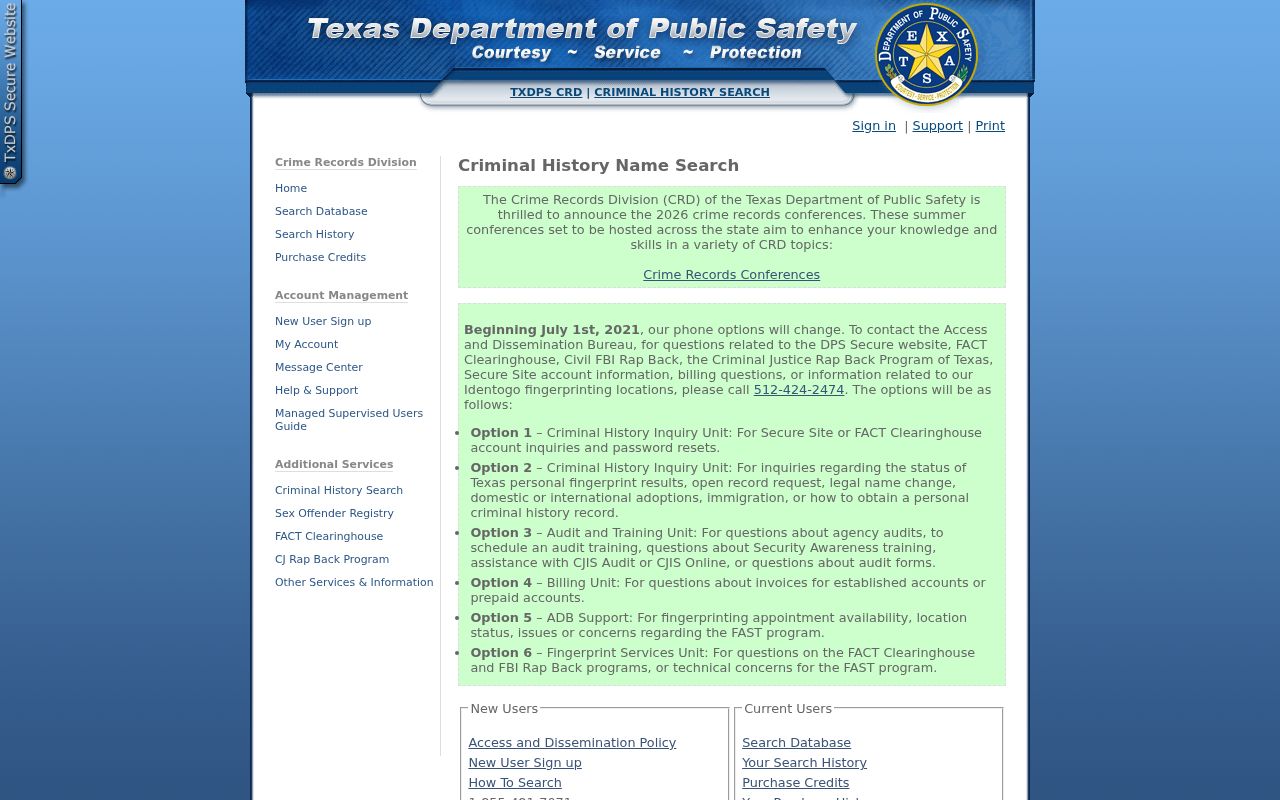
Use a local certified judgment when the exact Uvalde County disposition matters, since a state entry can be incomplete or delayed.
| Official route | Identity method | Published core cost | Best fit |
|---|---|---|---|
| DPS public CCH | Name and demographics | $1 credit plus card charges | Public Texas conviction/deferred history |
| DPS personal review through FAST | Fingerprints | $10 IDEMIA and $15 DPS components published | Reviewing your own Texas record |
| FBI EDO | Fingerprints | $18 FBI fee | Reviewing your own national identity history |
| Uvalde County clerks | Name or cause number | Confirm current copy fee | Local certified outcome |
| Sabinal Police | Report details | $6 report copy | Sabinal police report |
The $1 Uvalde County DPS Search
A DPS credit is consumed when a search is processed, even if the result says “NO MATCHING RECORDS.” Start with accurate identifiers. Last and first name are expected. A full middle name and exact date of birth can narrow common-name results. Sex and race are optional selection fields and should be used only when reliably known. The Multi-Entry control can queue more than one search, while Search or Submit processes the entry and uses the credit.
The DPS criminal-history instructions explain the public product, its cost, and its limits.

A no-match response is a paid search result, not a clearance letter and not proof that no Uvalde County record exists.
| Search control | Use | Matching note |
|---|---|---|
| Last and first name | Expected text fields | Use legal spelling and known variants |
| Middle name | Optional text | Helps separate similar names |
| Date of birth | Optional date | Strongly narrows a match |
| Sex and race | Optional selections | Use only reliable information |
| Multi-Entry | Optional queue | View and submit queued searches |
Types of Criminal Records
Different Uvalde County records answer different questions. An arrest report contains an officer’s account and the stated basis for enforcement. A booking sheet records intake, identifiers, initial charges, holds, and bond. A complaint, information, or indictment states the accusation filed in court. The clerk’s case file tracks docket events, settings, orders, judgment, sentence, costs, and appeal notices. DPS compiles a separate identity-based chronology from agency and court reporting.
- Arrest and booking records: The arresting agency owns its report, while the county jail owns its intake file.
- Criminal court case files: The District Clerk keeps felony files and the County Clerk keeps Class A and B misdemeanor files.
- Warrant records: District, county, justice, and municipal warrants can sit in separate court and law-enforcement systems.
- Custody and supervision: The jail covers local custody, TDCJ covers state custody, and the joint CSCD handles local community supervision.
- Registry listings: A local authority registers the person, while Texas DPS publishes the authorized statewide profile.
The Texas Judicial Branch court guide shows why felony, misdemeanor, justice, and municipal matters do not share one clerk.

That jurisdiction split is the key to choosing the right Uvalde County records counter.
Two Uvalde County Record Buildings
The historic courthouse at 100 North Getty Street is the clerk and court-record center. The District Clerk’s felony counter is identified as office 15, with the court coordinator in office 17. The County Clerk in office 20 holds constitutional county-court material, including Class A and B misdemeanor cases. By contrast, the Sheriff, jail, Justice of the Peace Precinct 6, and a second district courtroom operate at 339 King Fisher Lane. Going to the jail for a certified judgment, or to a clerk for an arresting officer’s report, sends the request to the wrong custodian.
District Clerk
100 N. Getty St., office 15
Uvalde, TX 78801
830-278-3918
Felony pleadings and dispositions
County Clerk
100 N. Getty St., office 20
Uvalde, TX 78801
830-278-6614
Class A and B misdemeanor files
Sheriff and Jail
339 King Fisher Lane
Uvalde, TX 78801
830-278-4111
Sheriff reports, booking, and custody
The Uvalde County District Clerk page identifies the local felony-record custodian.
The County Clerk page is the matching official source for county-court records.
Together, the two offices cover court files that a jail call or statewide name search cannot certify.
What a Uvalde County Criminal Record Shows
A Texas rap sheet usually begins with an identity segment and then groups events into arrest cycles. A local case file is organized differently. It centers on the cause number, court, parties, filings, settings, judgment, bond, costs, and later orders. Booking material centers on intake and custody. Public copies suppress Social Security numbers, victim and minor identifiers, and other confidential data, so an omitted field may reflect an access rule rather than a missing event.
| Name & Identifiers | Name, aliases, date of birth, Texas SID, FBI number, and fingerprint-linked identifiers where lawfully shown. |
|---|---|
| Arrest / Booking Data | Arrest date, agency, tracking number, booking details, initial charge, holds, and bond. |
| Charges & Statutes | Offense description, statute, complaint, information, or indictment data. |
| Disposition | Dismissal, deferred adjudication, conviction, acquittal, or another court outcome. |
| Sentence | Jail or prison term, fine, restitution, or community-supervision terms shown in the judgment. |
| Custody / Supervision | County custody, TDCJ placement, or public release and parole dates where available. |
Cause number, booking number, citation number, and DPS tracking number are not interchangeable. Keep the identifier from each office so later corrections can be matched to the right Uvalde County record.
Uvalde County Records Can Lag
Courts and prosecutors report outcomes back to DPS, but that feedback is not instant. Older paper files, rejected fingerprint submissions, spelling differences, and missing final dispositions can leave a state record behind the clerk’s file. DPS’s January 2025 completeness report illustrates the gap without measuring guilt or crime rates: at its measurement point, Uvalde Police showed 39 DWI arrests, 29 prosecution records, and 15 court dispositions for 2023. Sabinal Police showed one in each category.
If a DPS entry lacks the outcome, obtain the certified disposition from the correct clerk first, then contact the DPS data-error line at 512-424-7256. The court document supplies the fact needed for correction. A county docket may also be newer than re:SearchTX, whose coverage, documents, roles, and charges vary.
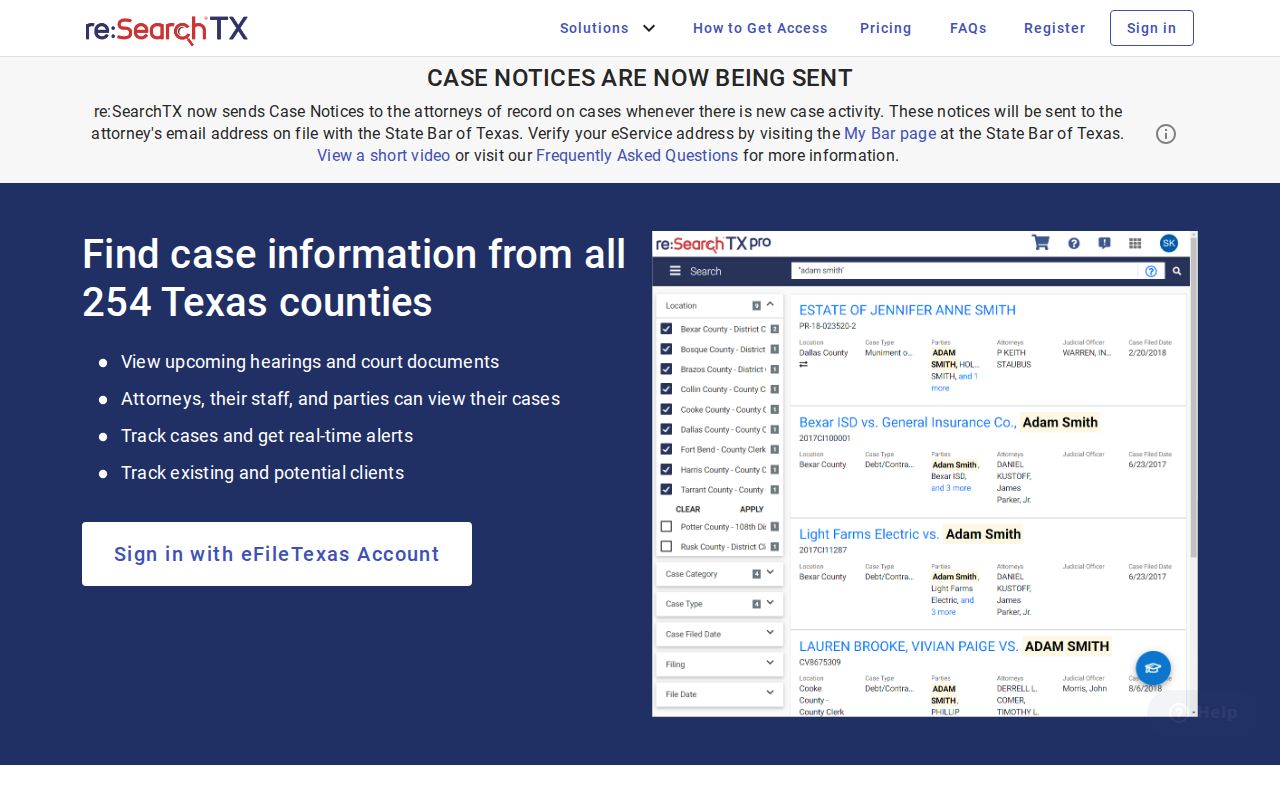
When an electronic result conflicts with a signed judgment, verify the current file with the clerk that holds the original.
Public Access Laws
The Texas Public Information Act generally opens existing government information unless an exception or another confidentiality law applies. It does not force the Sheriff to answer questions or create a new report. A narrow written request should name the record, date range, location, agency, and report number when known. Law-enforcement material may be withheld when release would interfere with detection, investigation, or prosecution. Separate rules limit access to confidential CCH, juvenile files, victim-identifying data, and records covered by an expunction or nondisclosure order.
Key Texas authorities:
Government Code §§552.021 and 552.108 make public information available while preserving defined law-enforcement exceptions.
Government Code §§411.083 and 411.135 restrict CCH but authorize DPS to publish the permitted conviction and deferred subset.
Code of Criminal Procedure Chapter 55A governs eligibility and procedure for expunction.
Code of Criminal Procedure Chapter 62 governs public registry information and protected fields.
Submit a request to the office that created the record. Ask for electronic copies when available and an itemized estimate before costly review. If a governmental body seeks an Attorney General decision to withhold material, the ordinary request deadline is ten business days, subject to the statute’s rules.
No Uvalde County Jail Roster
Uvalde County does not publish an official anonymous booking roster, warrant portal, or sheriff mobile app. The safe current-custody route is a call to the jail at 830-278-4111. Ask for the booking identifier, listed charge, bond, and responsible court. Then request the booking sheet or other releasable jail record in writing from the Sheriff at 339 King Fisher Lane. The sheriff’s site does not publish a report-copy fee, fixed turnaround, clearance-letter product, visitation scheduler, or inmate-services vendor, so call before relying on outside instructions.
If the person has transferred after sentence, switch to the TDCJ Online Inmate Search. Texas VINE can provide custody alerts, and the federal BOP locator covers federal custody. None of those replaces the local arrest report or a Uvalde County judgment. The absence of a county roster is also why unofficial jail directories should not be substituted for a government record.
Sealed, Expunged & Restricted
Juvenile justice records are generally confidential. Public copies may also redact victim identities, Social Security numbers, protected addresses, medical facts, and some family-violence or sexual-offense details. An order of nondisclosure restricts general public access to covered criminal-history information but leaves records available to criminal-justice agencies and entities listed by statute. Expunction is stronger. Agencies named in the order must return, delete, or destroy qualifying records and may not acknowledge the arrest except in narrow circumstances.
Texas recodified the expunction law into Chapter 55A effective in 2025. Eligibility depends on the outcome and timing. Acquittals, pardons, identity theft, certain dismissals or no-charge paths, and designated specialty-court completions can qualify. A conviction does not become eligible merely because time passed. Deferred adjudication more often points to nondisclosure, subject to exclusions and waiting rules. Confirm the local filing procedure and fee with the District Clerk, identify every agency and event number, and keep certified copies of any final order.
Historic Uvalde County Criminal Records
Modern portals do not reach every old Uvalde County case. The Texas State Library lists District Court minutes dating from 1857 through 1912 on microfilm. Those reels provide a credible archive path when a clerk index or electronic platform does not cover the period. Searchers should begin with a name, estimated year, court level, and any cause reference, then ask the District or County Clerk whether the original volume remains locally available or whether the microfilm inventory is the better route.
The Texas State Library Uvalde County inventory describes the surviving local court-record reels.
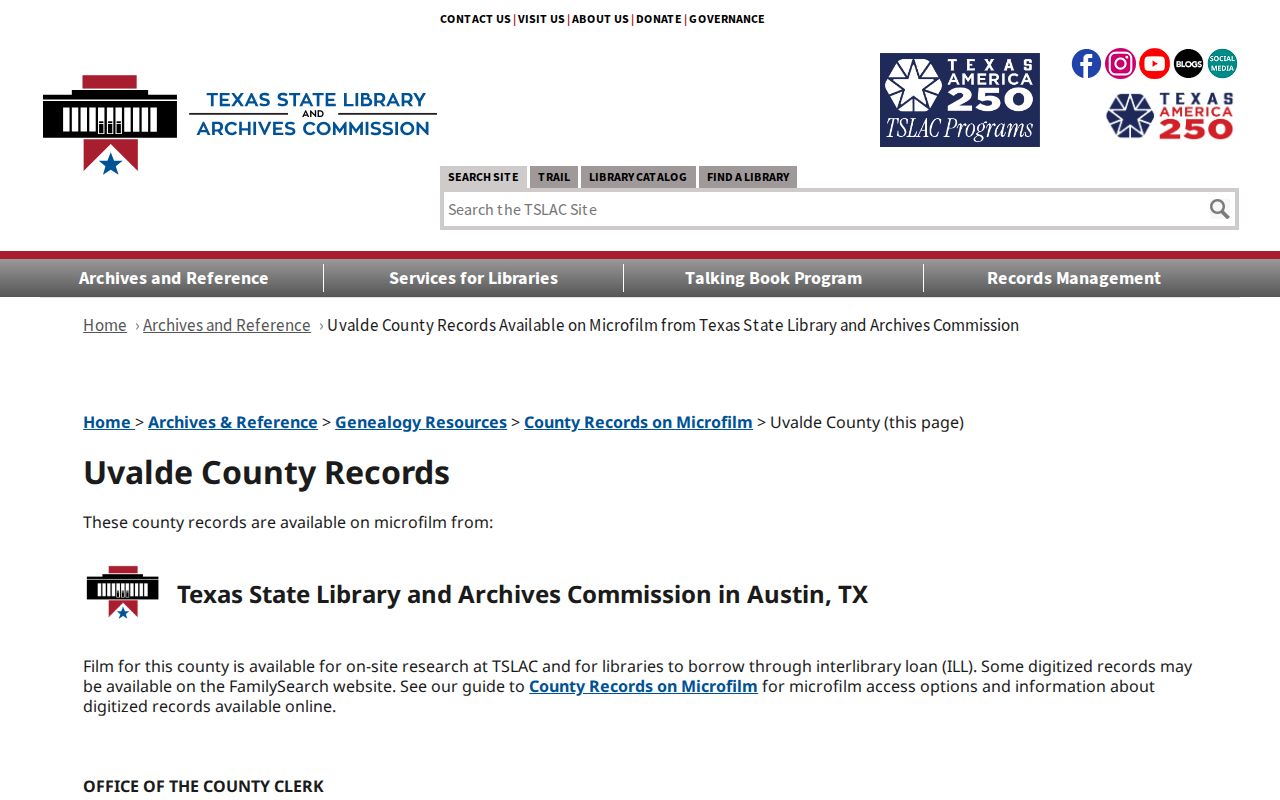
That archive supports genealogy and historical research without treating a modern name-search portal as a complete county history.
Criminal Records by City in Uvalde County
Census incorporated-place records identify only two cities in Uvalde County: Uvalde and Sabinal. Each police department owns the reports it creates, and each municipal court keeps its fine-only city cases. Higher charges move to the county or district clerk, while bookings go to the Uvalde County Jail. The city guides focus on those local handoffs rather than padding the list with Knippa or Utopia, which are not incorporated cities.
Uvalde Criminal History
15,417 residents · City Police requests and citation-number municipal searches
Sabinal Criminal History
Second incorporated city · Police, City Secretary, and phone-based court access
Use each city page for its report form, municipal process, and route into Uvalde County criminal court records.
Two Uvalde County Courtrooms
A 2025 standing order explains why a 38th District felony matter can move between buildings. The historic courthouse courtroom seats up to 180 and is large enough for a standard jury pool. The Justice Center courtroom seats 87, but it has better acoustics, a secure adjacent jury room, and better separation of participants. Jury selection usually stays at the courthouse; a seated jury may later move to King Fisher Lane. A docket notice and a later hearing notice can therefore name different locations without describing different cases.
The order also records practical limits at the 1927 courthouse. Sound can be hard to hear. Jurors cross public areas to reach a third-floor room, cannot all use the elevator together, and share restroom areas that bailiffs must secure. Confirm the day’s location with the District Clerk or court coordinator before traveling. Those local details explain the venue shift far better than a generic court directory.
Uvalde County Supervision Records
Community supervision and parole are held by different systems. The 38th and 454th Judicial District Community Supervision and Corrections Department serves Medina, Real, and Uvalde Counties. A judgment can establish that community supervision was ordered, but the county does not offer a public probation locator. The Uvalde adult probation number published by Sabinal Police is 830-278-1122. Officer assignments, treatment files, risk assessments, and personal supervision details may remain confidential.
The Texas Board of Pardons and Paroles makes release decisions, while the TDCJ Parole Division supervises people released on parole or mandatory supervision. A projected release or parole-eligibility date in the inmate locator is not proof of a board vote. Start with the court judgment, then use the appropriate CSCD or TDCJ channel for what it may lawfully confirm. A revocation motion or related warrant belongs back in the court file.